
Latin America has entrepreneurs, rising digital adoption and markets where plenty of needs still go unmet. What it hasn’t managed, at least not often enough, is turning that into companies that can scale beyond their home countries. Access to capital, cooperation between countries and the strength of local innovation ecosystems all get in the way. Those are the questions on the table in Medellín this week, where business leaders, investors and policymakers will share the same rooms.
From November 10 to 13, Universidad de Medellín hosts the Horasis Global Summit, organized by the Swiss think tank Horasis and co-hosted by Medellín’s City Hall. Organizers expect more than 1,000 business leaders, government officials, innovators and academics under the theme Building Tomorrow. It’s the event’s first time in Colombia and its third straight edition in Latin America, after Vitória and São Paulo.
For the tech sector, the draw is in the panels. Sessions on entrepreneurship, fintech and high-growth companies will bring together people from several Latin American markets and the United States. The common thread: what does it take to build a regional company when financing, infrastructure and regulation change so much from one country to the next?
Latin America’s next unicorns
One session asks what could produce the region’s next generation of unicorns. According to the program, growth will depend less on hitting a high valuation fast and more on pairing technology with execution and an expansion plan that lasts.
Founders from Brazil, Colombia, Mexico and the United States will take part. The question underneath: what lets a startup jump from its home market to international competition, now that investors want solid fundamentals and real results?
Next comes Building Entrepreneurial Pathways Across Latin America, with speakers from Brazil, Colombia, Peru and Uruguay. It begins with a contradiction. The region has a young population, more digital adoption and growing entrepreneurial activity, yet the chance to build and scale a company is spread unevenly. The panel will look at how cooperation between ecosystems can help companies grow past their home markets and connect entrepreneurs, investors and institutions more effectively.
Fintech: from disruption to infrastructure
Fintech gets its own session, with representatives from Lineru, TuBanc, Finti and Avanzo, plus Venezuela’s Finity Tech.
It starts from a change in the sector’s role. First came the apps that set out to take on traditional banks. Now the job is to become infrastructure for other economic activity: payments, lending and financial services that work at larger scale and reach people who still struggle to get into the financial system. Having Colombian and Venezuelan companies at the table adds a contrast between two markets with very different economic and regulatory realities.
Medellín as an investment destination
The choice of host city isn’t an accident. The local startup ecosystem keeps growing. According to Forbes Colombia, startups in the city raised US$216 million in the period covered in 2026, 38% more than in the same stretch of 2025. In StartupBlink’s global ecosystem index, Medellín reached 130th place, up 15 spots.
Against that backdrop, Colombia as a Long-Term Investment Horizon will focus on what international investors look at before committing capital to the country. Participants include ProColombia, Deloitte, private equity funds and investment firms. On the agenda: regulatory clarity, institutional strength and the sustainability criteria that shape foreign direct investment decisions. The goal is to understand what Colombia still needs to become a long-term destination for capital, and not just a source of passing opportunities.
The future of work is on the agenda too
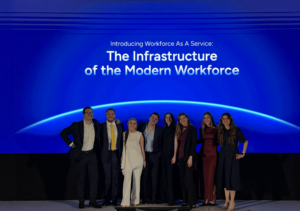
Another theme is how companies themselves are changing. Building Latin America’s New Architecture of Work will look at how distributed teams, AI-assisted workflows and on-demand hiring are changing the way firms attract and keep talent. Executives from Salesforce Colombia, Globant, TP MAR and XTrain will try to separate what is already delivering results from what is still just expectation about the future of employment.
AI runs through the whole program, with discussions on technology governance, human creativity and its effect on institutions. There is also room for planetary health and for Latin America’s place in an increasingly multipolar world.
Colombia’s Vice President, José Manuel Restrepo, attends as guest of honor, which adds another layer to the conversations about economic development and the country’s place in the global economy.
With Building Tomorrow, Horasis is putting forward an agenda that goes beyond showcasing new technology. It gathers the people who build companies, move investment and shape policy to ask what Latin America needs to do to carry more weight in the global economy.
For Medellín, it’s a showcase for its ecosystem in front of an international audience. For entrepreneurs and investors across the region, it’s four days to wrestle with one question: what will it take for Latin America’s next wave of tech growth to cross national borders?